
The beginning of a new semester at a school is one of the greatest and worst times to start fresh. For better or worse, there is a total uproot of everything that currently has been, for a chance at something completely different, and there is always so much to learn. There is no staging, or progression, and it is all happening at once, with or without you. To put it simply, there is a lot going on.
However, that is why people start fresh in the first place, to be thrown into the fire to expand their perspective. Perspective, narrow or wide, is like a fingerprint, part of, and unique to, every person. The thing about perspectives is that they are also a part of spatial geography, or as defined by Penn State1, a world view that prioritizes things based on certain proximity or connection. It leads people to ask questions about their surroundings (2026).
But just like every aspect of life in the 2020s, the internet and its related technology have disrupted these perspectives. Instead of having a basic limit that people can push on their own accord, hundreds of pieces of information are shared every minute, with the number of pieces consumed close behind. And even though people wish it was not so, there is a limitation to the information humans can process.
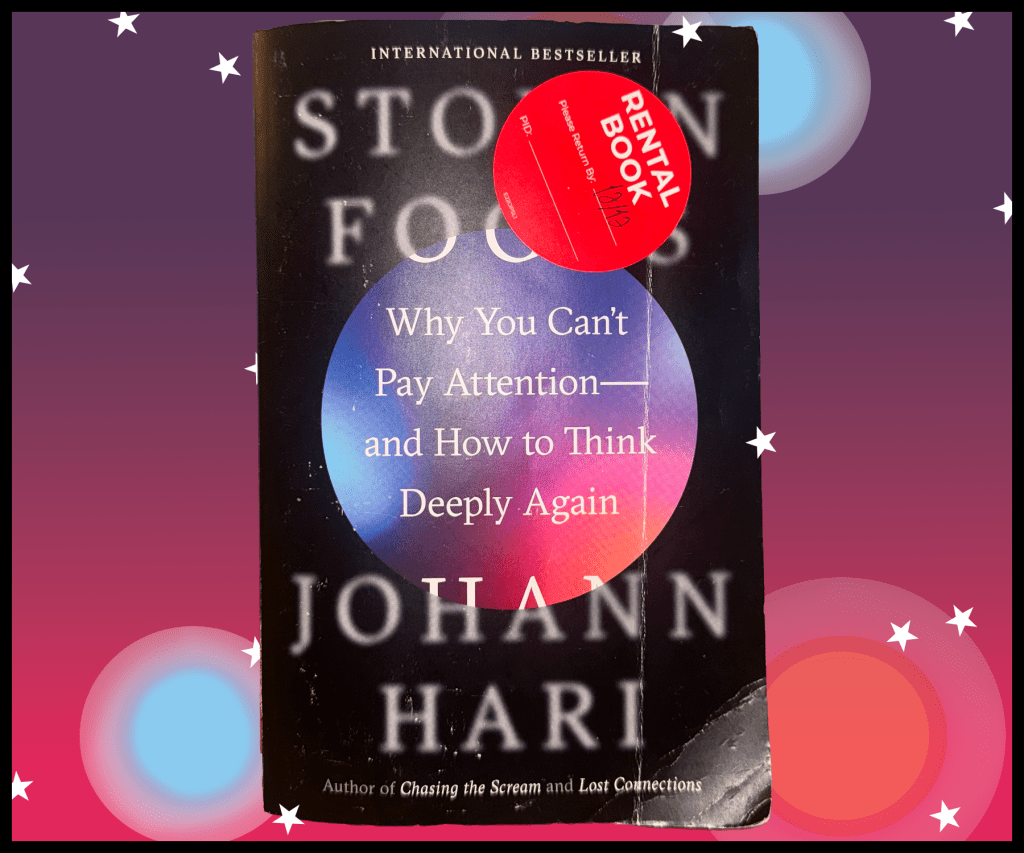
This idea of limited brain resources is explored in Johann Hari’s “Stolen Focus”, especially in his discussions with physicist Sune Lehmann. Speed is the key aspect of the internet, it makes you feel connected, like you know what the whole world is doing, and that you can have it at any time without repercussions (Hari, 32, 33)2. But as Hari and Lehmann chat, that idea is shown to be a fantasy. The amount of information becomes exhausting for your brain to keep up with, and there is no room for any depth, all the content is now consumed at a surface level.
Conversely, the reason why Hari wrote his book was to take back his life in a way, to step away from the internet and its claws for a new lease on life. Yet, from his personal spatial geography and perspective, in my opinion, he misses some things, at least so far in my research.
Hari details how he visited famous locations, with them only to be plagued with people livestreaming and taking photos (Hari, 8)3. But to me, this environment is another effect of the internet, the lack of control, how online spaces gain power and begin to infiltrate every part of life, with no escape. This is not the tourists’ fault, the internet has created this idea of a perfectly curated feed, with the expectation that you are living life to the fullest, that you can do everything. Not only is this expectation unrealistic, but it can also be harmful.
Hari has had great intentions so far, but sometimes his perspective on his journey with focus and attention lacks a greater context of other cultures, their norms, and generally a couple other things. That is not his fault or something bad necessarily, but it is a jumping off point for a larger conversation about how much is too much, and what a “safe” level of connection, or “online-ness” is.
This is my very first blog post, so if I have missed anything or you’d like to add to the conversation, comment down below!
Citations:
- 1.3 Geography: Developing a Spatial Perspective | GEOG 571: Intelligence Analysis, Cultural Geography, and Homeland Security. https://courses.ems.psu.edu/geog571/node/425. Accessed 30 Aug. 2026. ↩︎
- Hari, Johann. Stolen Focus. First, Crown, 2023. Paperback, Originally published by Bloomsbury Publishing Plc, 2022. ↩︎
- Hari, Johann. Stolen Focus. First, Crown, 2023. Paperback, Originally published by Bloomsbury Publishing Plc, 2022. ↩︎


Leave a Reply