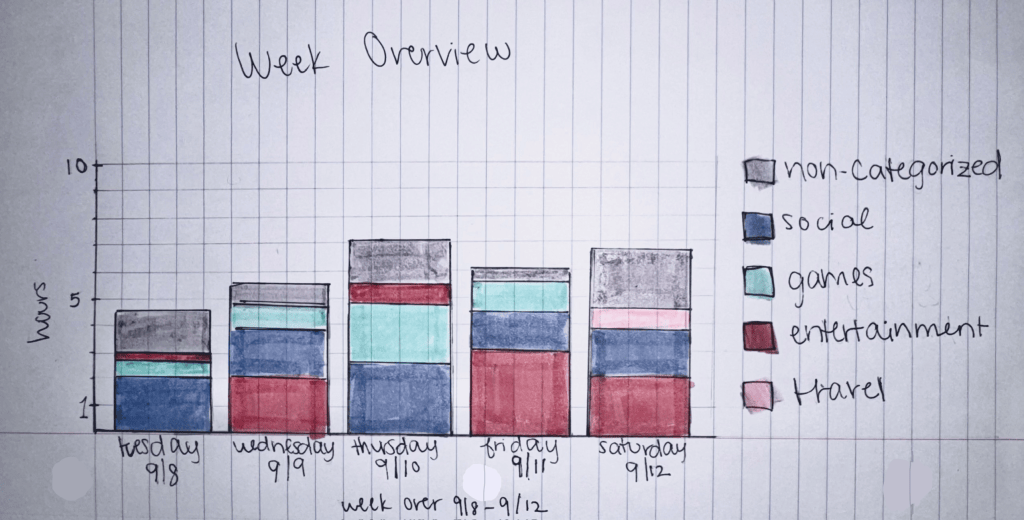
I have never been someone that has been proud of my screentime. Even if there is a stretch of days or a week where it is lower than average, my first thought is almost always, “it really should be lower.” So, I was interested to see where this week and the data detox project would take me.
Before I get into the data that was collected and my overall thoughts, it is not lost on me the realizations that Johann Hari has made so far in “Stolen Focus”, where he validates the idea that individuals are not solely at fault for their social media addiction. Yes, social media apps and platforms are specifically designed to keep you there for as long as possible. This goal is accomplished through different means, with Aza Raskin’s creation of the “infinite scroll” being one of them, or better described as endless content that never runs out (120)1. Still, to fully understand how I feel about my media consumption, especially my time spent on my phone, looking at the hard facts can serve as a bit of a reminder and wake-up call. For this, I took inspiration from Giorgia Lupi and Stefanie Posavec and their “Dear Data”2 project and created my visualizations by hand with pens, pencils, and highlighters.
For the project I decided to cut out two platforms I did not care about (Snapchat and X), and two platforms I did care about (TikTok and YouTube). I did it this way because I thought it could be interesting to see the difference about how easier it could be to cut out one platform versus another. Also, I mainly got my data from Apple’s screentime function in settings on my phone which seemed to be pretty accurate, though their visualizations could be confusing at times.
Last week, Sept. 1 through Sept. 5, I averaged 5 hours and 39 minutes a day as my control group. This week included no app exclusions and no app limits, apart from a limit of 45 minutes a day for TikTok and an hour a day limit for Instagram, both of which I have had in place since the summer.
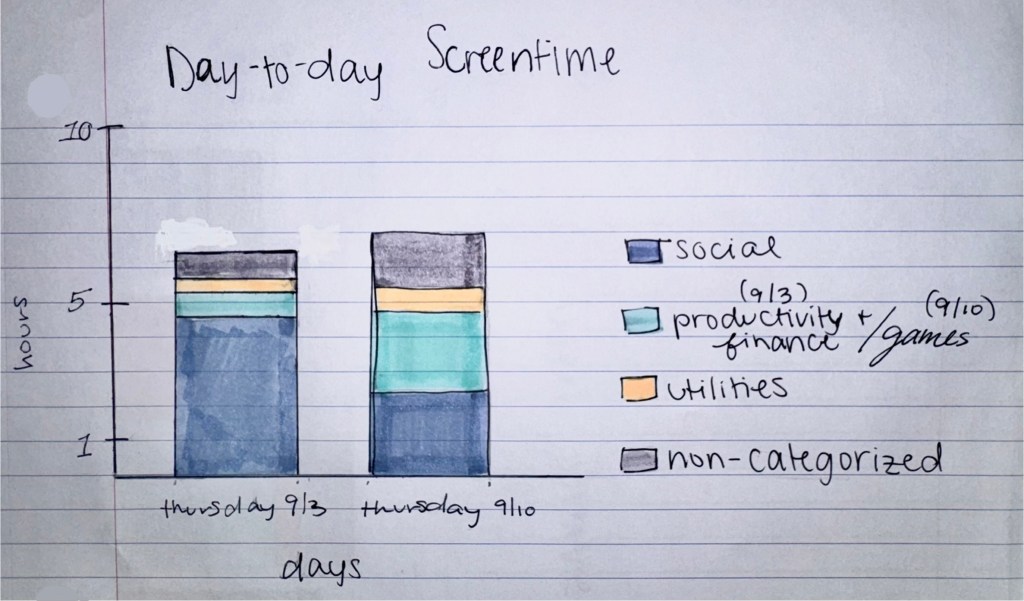
For the data detox week of Sept. 8 through Sept. 12, I averaged 4 hours and 34 minutes a day in total screen time, overall spending about an hour less on my phone per day (week overview graph is the head image at the top). I also compared two specific days (pictured below) of Sept. 3 and Sept. 10, which surprisingly, the data detox day had more screentime. I think this is because instead of really cutting out phone time, I just supplemented with other apps. If I couldn’t use TikTok, I would use Instagram when I could. If I couldn’t use YouTube, I would use a streaming app and watch a whole movie. I did not really feel better or feel like I was spending less time on my phone, even if I was in some cases.
My prediction was also right in that cutting out the apps I felt like I did not care about was way easier than cutting out the ones I did. I opened Snapchat a couple of times over the detox week (which was mainly because it was the beginning of the week and I forgot I started the project, to which I then put screen limits on all included apps for the rest of the time). And as of this Sunday I am writing this post, I have downloaded the photos I wanted and have since deleted my Snapchat account and the app from my phone. Honestly, it was something I was thinking about for a while, and this project showed me it really was just that easy. I will not be deleting X, as the main reason I have it is for a professional account for extracurriculars, though I rarely use the app.
TikTok and YouTube were a lot harder though, and I especially found myself wanting YouTube after a day classes and wanting to unwind, or if I was eating a meal by myself. TikTok can also just be a fun way to fill time, or see what my best friends are sending me. It was also during this week that when I explained what I was doing to my friends, many said they would hate to go without their platforms, especially YouTube, that platform is the one I heard the most.
While I do not think I was perfect, this project was helpful and I hope this can be the beginning of a slow working towards an overall lower screentime that can also be offset with healthier choices in my day-to-day life.
Thanks for reading! Remember you have to work for growth, but please be kind to yourself in the process, we’re all just trying the best we can!
Citations:
- Hari, Johann. Stolen Focus. First, Crown, 2023. Paperback, Originally published by Bloomsbury Publishing Plc, 2022. ↩︎
- “THE PROJECT.” Dear Data, http://www.dear-data.com/theproject. Accessed 13 Sept. 2026. ↩︎
 Meg Buckley | Through the Lenses
Leave a comment